Hollow-core Fiber (HCF) — an optical fiber with an air/gas/vacuum central core, guided by photonic bandgap or anti-resonant mechanisms instead of total internal reflection (TIR) of conventional solid-core fibers.
1. Core Guiding Mechanisms & Types
Hollow-core Photonic Bandgap Fiber (HC-PBGF/HC-PCF):Cladding is a periodic hexagonal lattice of air holes. Forms a photonic bandgap that traps specific wavelengths; narrow bandwidth, strict fabrication tolerance, more bend-sensitive. First demonstrated 1998.
Hollow-core Anti-resonant Fiber (HC-ARF/ARROW):Current commercial mainstream. Cladding is one or multiple rings of thin-walled silica capillaries. Anti-resonant reflection confines light via phase interference. Wider bandwidth, looser manufacturing tolerances, far better bending performance (e.g., 5 mm bend radius with minimal loss). Common designs include nodeless, revolver-type.
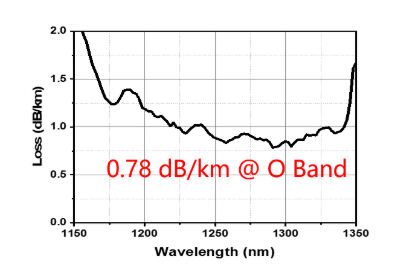
Hollow Core Fibers The TTF-NIR 1310-S hollow-core fiber exhibits transmission losses of less than 1 dB/km in the O-band. Combined with its 31% lower latency, it becomes an ideal choice for intra-datacenter optical transmission.